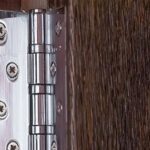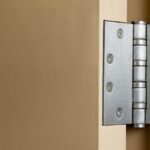
Seemingly unimportant and often overlooked, hinges for doors are nevertheless crucial components in any home renovation project. They ensure doors open and close smoothly, bear the weight of doors of varying weights and sizes, and define interior and exterior styling with different shapes, materials and finishes.
How Does a Door Hinge Work?
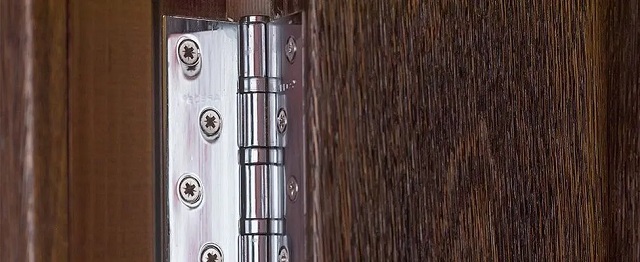
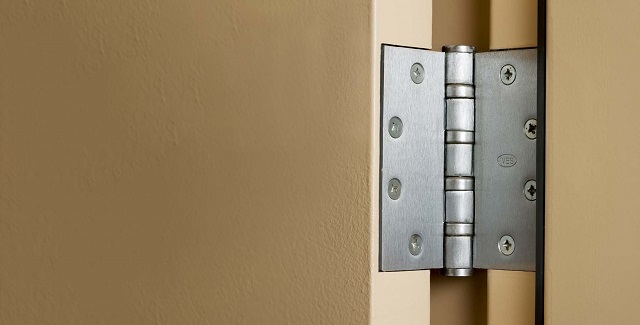
A hinge is a simple mechanism that allows two objects to rotate relative to each other around an axis of rotation. There are three main parts in door hinges: the leaves, or the flat sections that attach the door to the frame, the knuckle, or the cylindrical component created by the leaf edges, and the pin or rod that slides through the knuckle, allowing the doors to open and close.
Leaves are usually rectangular and secure the door to the frame via fasteners. They’re sized and shaped according to the door weight and size. Knuckles provide a smooth pivoting point and connect the two leaves. They also evenly distribute the weight of the door and ensure the door and frame are perfectly aligned. This provides smooth door movement.
Lastly, pins work with knuckles to ensure stability and that the door opens and closes without resistance. They’re also the main load-bearing element that prevents doors from sagging. Optional components are end caps that mostly serve an aesthetic purpose, but also enhance security by preventing tampering and reducing maintenance by limiting dust and debris.
Common Hinge Types
Hinges can be visible or concealed, one-sided or reversible, and fixed or adjustable. This simple door hardware has evolved to accommodate different exterior and interior doors in both residential and commercial settings. While there are scores of different door hinge types, the most common include:
Butt hinges
Consisting of two flat leaves and a 3- or 5-knuckle layout, butt hinges line doors, panels, cabinetry, gates, windows, and more. Their versatility is due to their high strength and stability for doors of different sizes and weights, high durability and corrosion resistance with stainless steel or copper alloys (e.g. brass) and a clean, flush fit. They’re also affordable and easy to maintain. Choose from a wide variety, ranging from simple bearing butt hinges with a single pin, spring-loaded hinges for simplified opening and closing, lift-off types for easier emergency access in commercial and industrial applications, and hinges with rigid pins for enhanced security.
Concealed
Hidden from view, concealed hinges provide a flush fit while staying out of the way. Their main purpose is to accentuate the door by being embedded into the door leaf and into the jamb. While chosen mostly for the invisible look, concealed hinges can additionally be adjusted in three axes – height, width and depth, providing adaptability for different settings and doors. They’re also designed for smooth, quiet operation, often with soft closing mechanisms. Their enclosed location and lack of protruding parts prevent dust and debris and increase safety in high-traffic areas such as hospitals and offices.
Pivot
A newer type used with exceptionally large and heavy doors, pivot hinges work by creating a single vertical point at the top and bottom of the door, allowing doors to swing open along a central axis. They provide the needed stability for bigger doors in areas like hotels, restaurants and stores, distributing weight evenly, and allowing effortless opening and closing. The hinges are also common in designer homes, with oversized doors in metal, stone or glass.
There are three main types – offset, with the pivot just outside the door frame, set at a 90-degree angle; intermediate hinges positioned near the centre of the door; and centre-hung hinges with a pivoting point at the centreline of the door’s thickness, allowing it to rotate a full circle.
Factors to Consider When Buying Door Hinges
Door Width, Thickness and Height
For compatibility, security and seamless functionality, get hinges that suit your doors in terms of door width, thickness and height. This correlates with the size of the required hinge. For standard height internal doors with thicknesses of 35 to 40mm, choose 100mm by 75mm hinges. Thicker, wider and taller internal and external residential doors require 100mm by 100mm hinges, while the largest doors lining designer homes, hotels, warehouses and retail stores can reach up to 150mm by 150mm.
Materials and Finishes
Stainless steel, steel, brass, aluminium and iron are the most common materials in a door hinge. Choose stainless steel for high strength and corrosion resistance, coated and heat-treated steel for internal doors, brass for a classic look in older homes and door styles, with the added benefit of lower wear, and aluminium for a lightweight yet durable option in external doors. Bronze and iron are also popular options in stylised indoor applications.
Also consider colours and finishes, especially if style and aesthetics are the reasons for choosing new hinges. Matte black, stain white, gunmetal, brushed brass and brushed stainless steel all have their distinct look.
Lastly, change the hinges on sagging and creaking doors. And periodically inspect for signs of rust, cracks, worn or stuck pins and missing fasteners. Shop for hinges from reputable manufacturers and retailers that meet industry standards and regulations and come supplied with defined warranties.